EN
ENThe “D.N.A. Launch Model” Guide
You know what you sell, yet every launch gets assembled from scratch all over again: new copy, a new page, the same doubts. The “D.N.A. Launch Model” Guide puts it all into a single sequence of actions — avatar, offer, headlines, funnel — built from the end back to the beginning, so the product sells without a sales department and without a budget for endless testing.
This is the working method I have used since 2008. You read, write out your own wording, build the page — and the first launch comes out packaged, not scraped together on willpower.
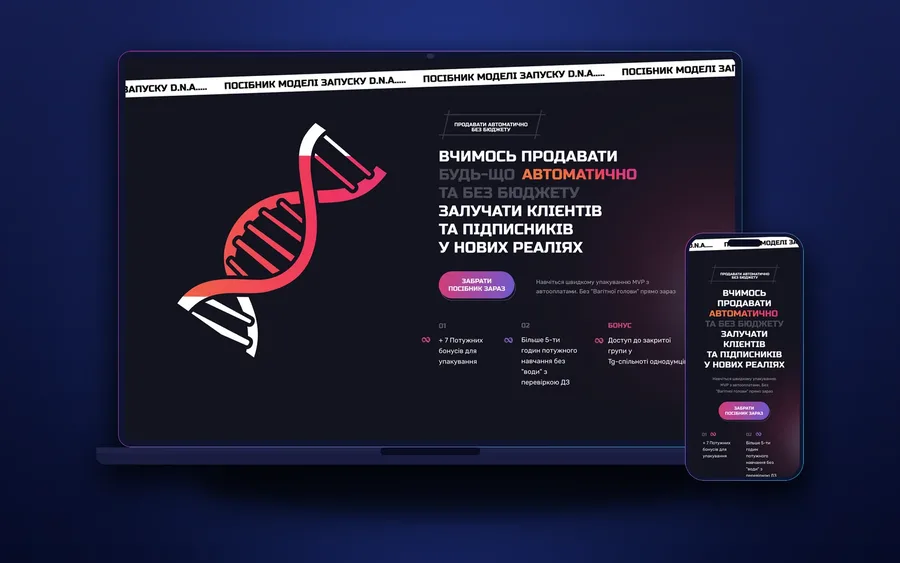
Advertising becomes a lottery when you don’t know who needs you. A site stays a business card when the offer is made up in your head. The guide puts the launch steps into working order.
What you take from the guide
-
1
Avatar. The customer’s pains and desires written out in 5–10 wordings, of which only the sharpest remain — those go into the headlines.
-
2
Offer. One sentence people pay for: what a person gets, in what time, and what they’re finally free of.
-
3
Headlines and bullets. The scripts take wordings from the pain table, so the page gets scanned in three seconds and people stay on it.
-
4
Funnel. The path from first touch to automated payment, built from the end to the beginning: the result first, then the steps to it.
-
5
Tools. How to build an MVP page on DigitTime.Top and connect automated payments without hiring a developer.

Launch from your head vs. launch by D.N.A.
- The offer is written the way it feels — not the way people buy.
- The headline praises the product instead of naming the pain.
- The page is ready, but who exactly will come to it is still unknown.
- Ads are switched on blind, and the budget melts away with no answer to “why”.

- Avatar first: who needs you and why they buy from you.
- The offer and headlines are built from the customer’s words using scripts.
- One page that gets read to the end and paid on.
- Every next launch repeats the order instead of starting from scratch.

Before you open it
-
How is the guide different from the D.N.A. Model course?
The guide is the method at your own pace: you read and apply it yourself. The course adds a mentor, reviewed homework and an Academy certificate. Start with the guide if you’re used to working on your own; with the course — if you need someone who won’t let you stop.
-
I’m not a marketer. Can I do it?
Yes. The method is written for the owner, the expert and the course author — people who know their product, not ad accounts. Terms are explained where they first appear, and every step ends with a concrete action.
-
Does the method work for my product?
The D.N.A. Model isn’t about a niche — it’s about your uniqueness in the market: who needs you, why you specifically, and how to convey it. The mechanics are the same for experts, schools, services and product businesses — only the wording changes.
-
What to do after the guide?
Build the page and launch. Then — the D.N.A. Model course with a mentor, the Evolve.Place Academy, or a NEO site once you have something to sell.

Reading isn’t enough. Give the method 60 days
The guide reads in an evening, but it works when you apply it. Write out the avatar, build the offer, put up the page — then repeat with the next product. After 60 days of practice the order becomes a habit, and launching stops depending on your mood.
Open the guide
Other products
60-Minute Consultation: A 30-Day Plan
A 60-minute session with me: we go through your product, audience and funnel, find what blocks sales and agree on a plan for the next month.
Learn more
Website & Funnel Audit: Where You Lose Leads
There is traffic, but leads are few or the wrong kind — and nobody can tell who is to blame: the ads, the page, the form or the offer. The website and funnel audit is a walk along your customer’s path from click to payment: page structure, copy, speed, analytics, forms, events for your ad account. I look at it through your customer’s eyes and through the eyes of someone who has been building sales systems since 2008.
The result is a list of the places where you lose leads, ordered from the most expensive down to the small stuff, plus a 30-day plan of fixes.
Learn more
Express Digital Strategy: A Route to Your First Sale
The product is ready or nearly ready, but where to take it is unclear: channels, budgets and copy get picked at random, and every attempt burns money without ever answering “why didn’t it work”. The Express strategy is a quick map drawn for your niche and your market: who needs you, what offer you lead with, which channels you use and in what order.
The result is a document you can read in an evening and a week-by-week implementation plan. It is written around your market, not around what we could sell you, so it contains exactly as many tools as your first sale requires.
Learn more
Digital Strategy Standard: Growth After MVP
The MVP has been tested, the first sales are in — and this is exactly where most people stop: the product needs refining for those who actually buy, and marketing stops paying off on one-off efforts. Standard is the next-level strategy that flows out of Express: we look at what the test showed, refine the offer and the product, and map out marketing activities and channels so that growth no longer depends on the mood of your ads.
The format is individual: there are no price tiers here — there is your market, your numbers and a week-by-week implementation plan.
Learn more